La Mezcla – Neighborhood Activation Through Service Design
How have San José’s residents redefined mobility and gathering after COVID-19? Through guided walks with city-planning experts, interviews, and nighttime observations, we discovered that mobility in the city is deeply tied to emotion, safety, and belonging. La Mezcla emerged as a regenerative pathway to reactivate a neighborhood impacted by the pandemic and communal narratives—through food, place, and shared experience.
DAte
Feb 28, 2021
Category
Service Design
Reading Time
12 Min
Brief:
How might we design mobility services and interfaces in San José, Costa Rica for a more regenerative world?
Timeline: 1 month
Team:
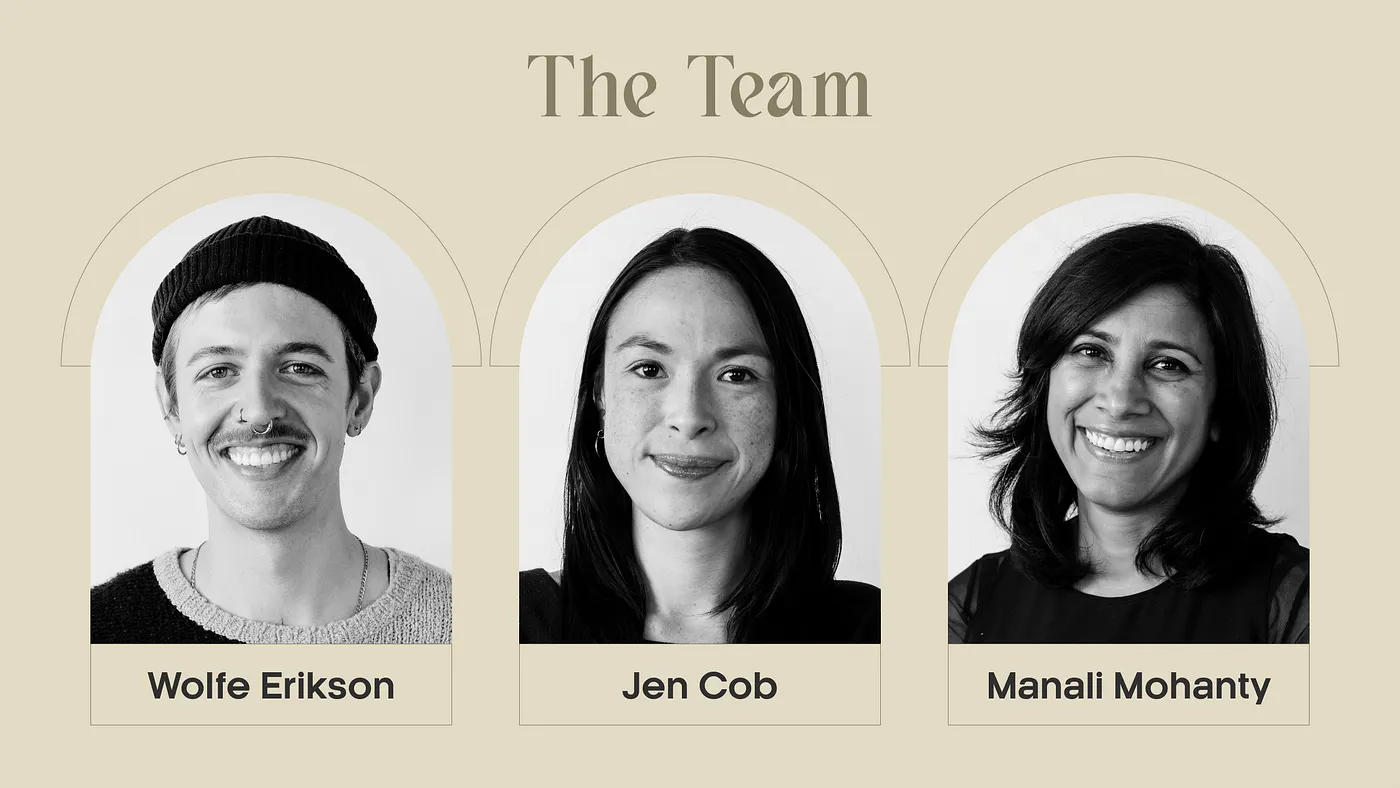
Wolfe Henry Erikson · Jen Cob · Manali Mohanty
Methods:
Guided walk with city planning expert · Nighttime observations · Timed observations of public gathering spaces · Resident and business interviews · Intercept interviews with local law enforcement
Note of Consent:
We explicitly asked research participants if they might be willing to have their image – both in photos and videos – to be used in this case study. Only those that have confirmed their consent are present here.
Observational Studies
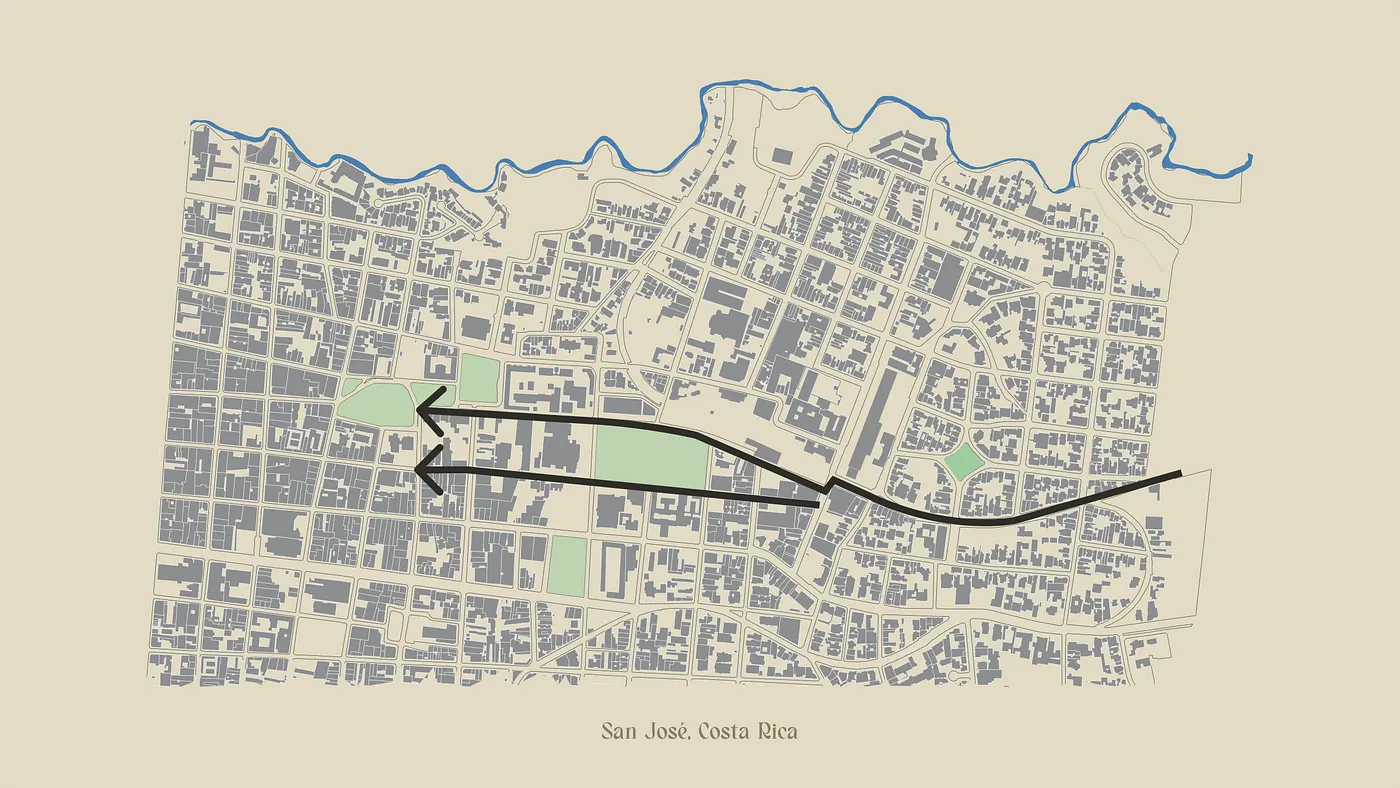
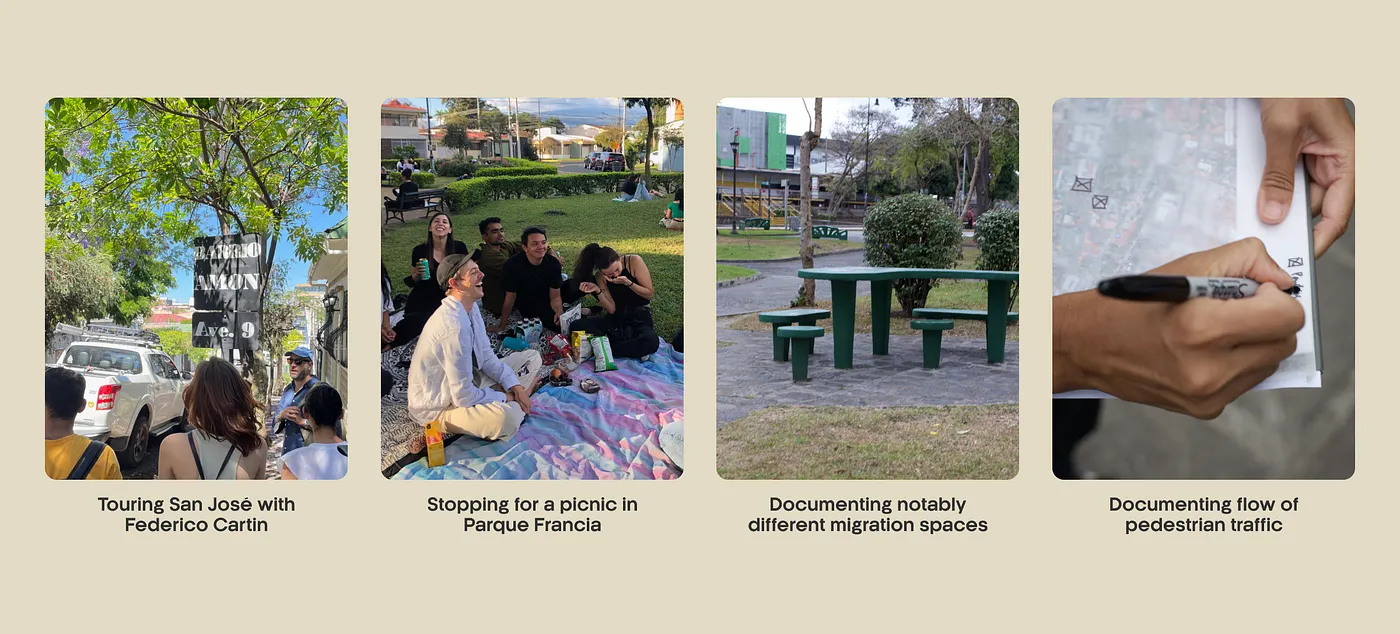
Urban planner & economist Federico Cartín guided us through the city to show the daily rhythms of moving through San José. Bike lanes were narrow and slick, sidewalks irregular, and train crossings prone to accidents. We walked the city’s main east–west corridor, noting the rhythm of its public green spaces. Some pulsed with chatter and street life. Others sat empty.
Discovery Research: Conversations with Local Residents
Our initial interviews centered on a simple question:
What motivates people to move through San José,and what holds them back?
Some responses we heard included:
“I’d love more places where people can hang out without any concerns or risks.” — Alita (she/her), 22
The risk Alita was referring to here was regarding covid infection and seeking the ability to move safely through San Jose as a trans woman.
“We had to find other ways to hang out after Covid… we usually go to friends’ houses.” — Tony (he/him), 28
“Some people think that San Jose is an ugly place. It’s not just transportation, or how we go to San Jose. It’s also about the feeling of San Jose, what we think about our city. That’s an important issue to talk about.” — Margarita (she/her), 31
The city was beginning to open up, but it seemed the local community was struggling to reconnect in ways that felt safe and accessible. An emerging story began to take shape: while mobility challenges certainly existed, there was also an undercurrent of fear and uncertainty that created an additional barrier to gathering with confidence.
Perceptions of Safety
We conducted another round of interviews with residents, asking them to map which parts of San José felt safe versus which they avoided due to neighborhood reputation.

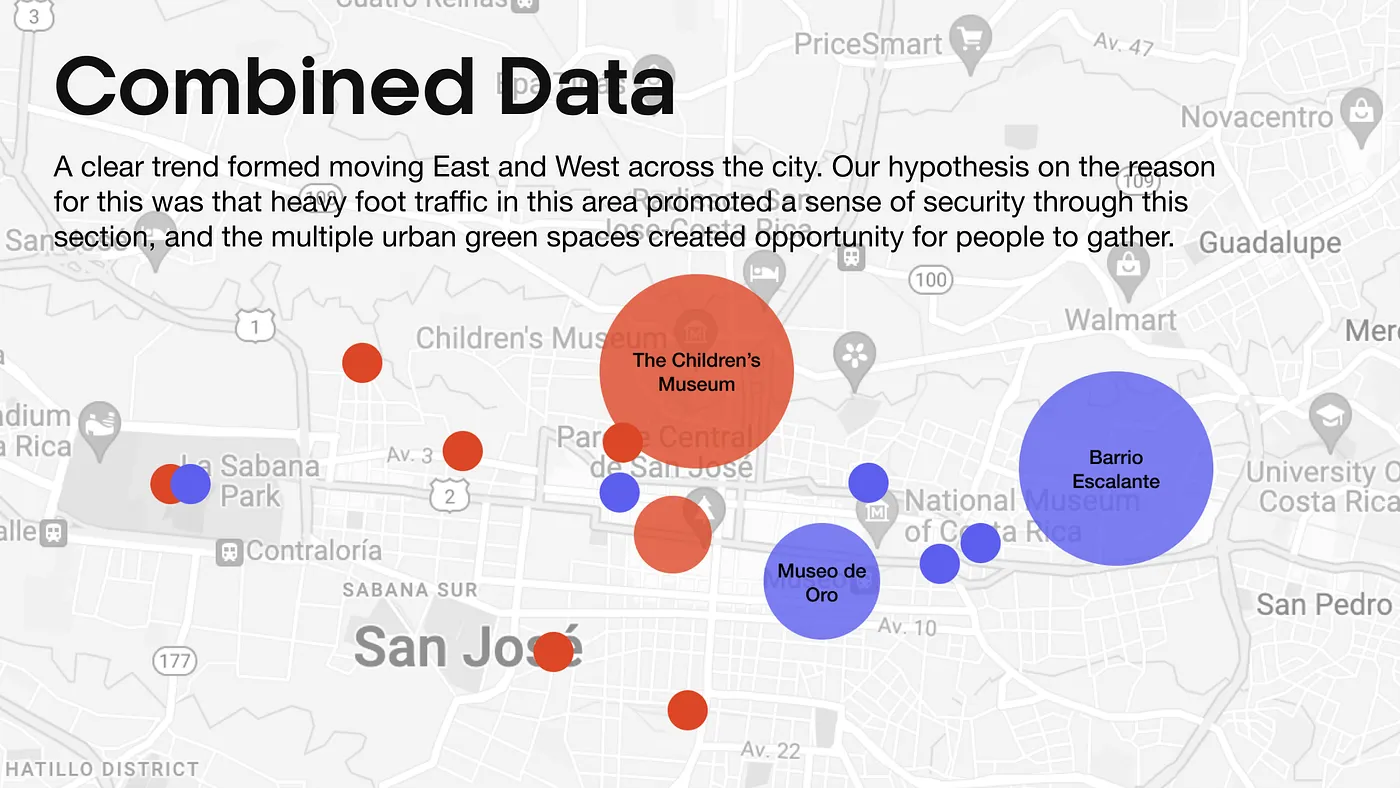
An area of interest that surprised our team was the juxtaposition of Parque Francia (A park within Barrio Escalante) and Parque Nacional (Underneath the Children's Museum). Parque Francia was a well known bustling hub for community gathering, while Parque Nacional held negative reputations for it being unsafe, despite it being only a few blocks away from Parque Francia.
Through intercept interviews with local business owners and police near Parque Nacional, we uncovered a striking mismatch between the reputation for crime around Parque Nacional and the actual rates of incidents.
At Pizza Oliva, a local restaurant on the corner of Parque Nacional, the owners told us the park “used to be dangerous” more than a decade ago. It was associated with prostitution and other crime, but they assured us “nothing like that happens anymore”. They expressed confusion about why the park remained empty, and fear about the impacts it had on their business.
Through intercept interviews with local officers patrolling nearby Parque Nacional we were able to confirm this: the area had low crime rates, and was regarded as “very safe.” Yet many residents still avoided it, holding onto the story that it was risky. They mentioned that Parque Nacional was no riskier than Parque Francia, a bustling outdoor green space only a few blocks away from Parque Nacional, and although Parque Nacional is about 5X the size, remained empty.
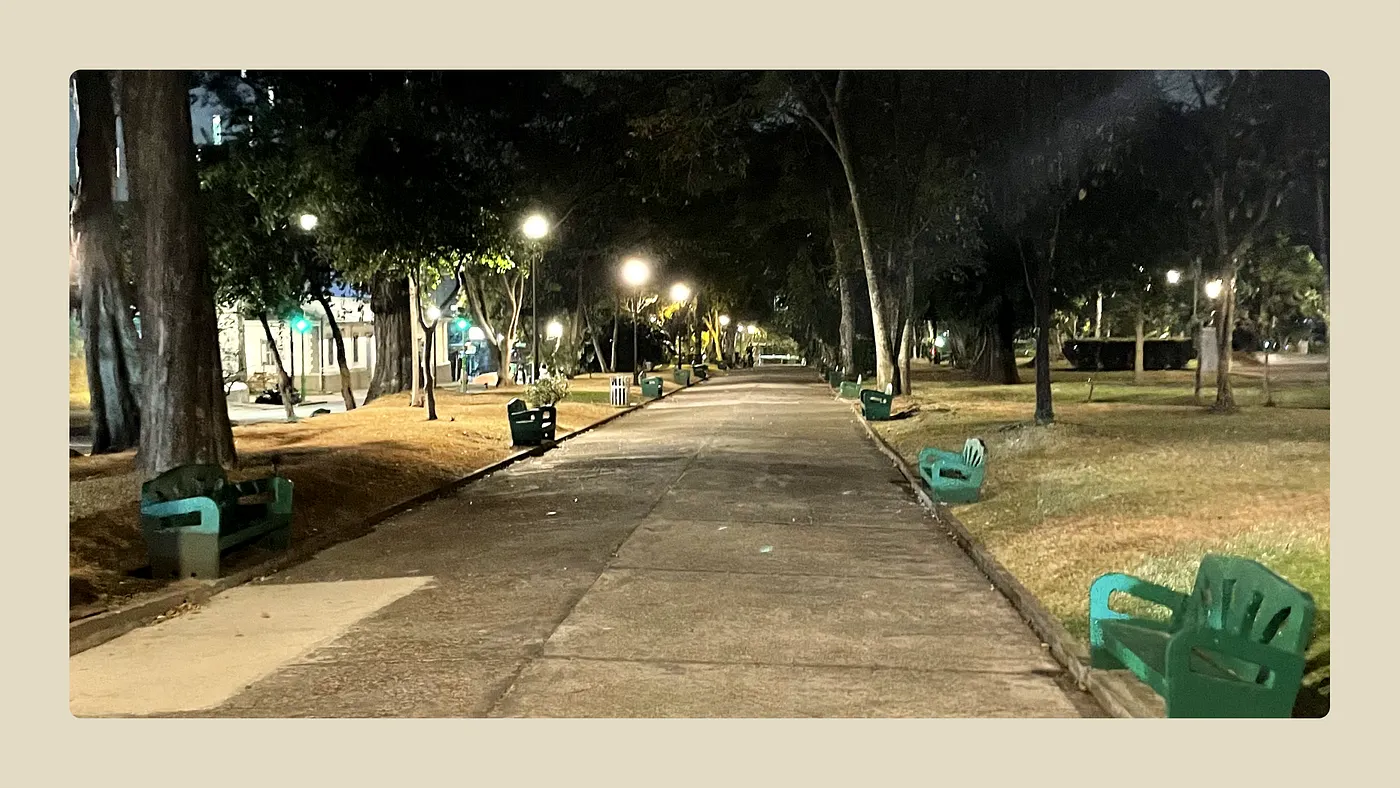
Parque Nacional
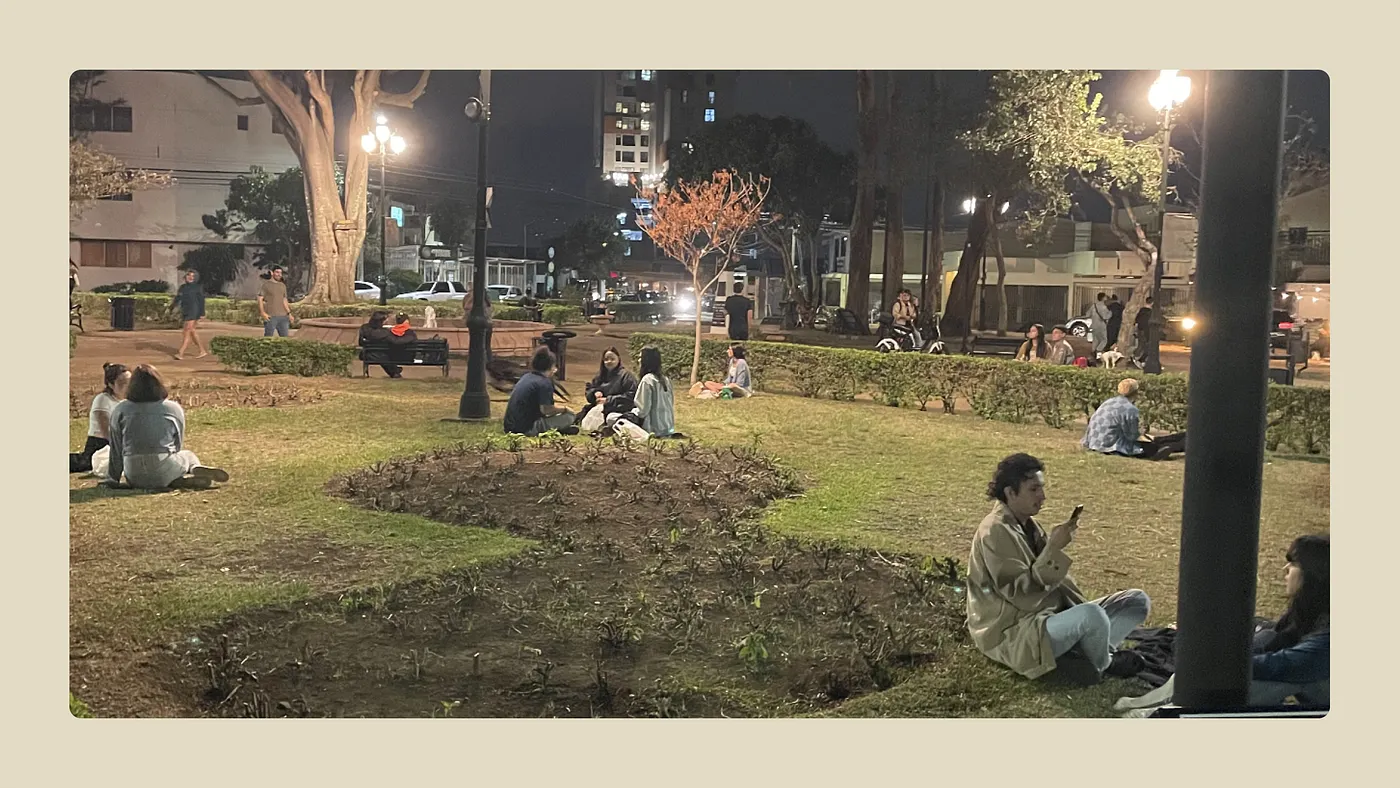
Parque Francia
Emerging Insights
Stories shape movement. Outdated narratives of danger can keep even safe spaces deserted.
Safety is collective. People feel secure when they expect others to be present.
Beauty and social life are intertwined. Well-lit, open, and cared-for spaces invite gathering.
These patterns reframed our challenge: if mobility is the precursor to gathering, then to restore movement, we first needed to restore a sense of security and trust.
Hypothesis
Why do some parks thrive while others sit empty? Our observations precipitated into 3 needs that must be present for a space to be inviting: visibility (openness of the space), amenities, and association.
Parque Nacional’s barriers: lingering negative reputation, dense tree cover, poor lighting, and benches that discouraged face-to-face interaction.
Parque Francia’s draw: open sightlines, nearby food and bathrooms, strong lighting, and an established social rhythm.
Problem Framing
How might we mobilize young adults to gather in public spaces of San José, in a way that rehabilitates areas with a negative reputation and motivates future mobility to that area?
Shaping the Solution
We explored how neighborhood rehabilitation might work in San José’s context. Through interviews and additional research like The Social Life of Small Urban Spaces by William H. Whyte, we identified key design levers: flexible seating, visibility, and the magnetism of food.
To understand how to anchor these elements culturally, we spoke with Yuliya Bruk, Creative Director of Future·Arts, who uses art and urban placemaking to help communities rewrite their relationship with place.
This inspired us to imagine interventions that could layer new memories onto Parque Nacional — pop-ups, community dining, and shared experiences that could shift perception through participation.
The Intervention: La Mezcla (The Mix)
La Mezcla is a regenerative approach that connects residents seeking safe, lively gathering places with local restaurants recovering from pandemic loss.
In early 2022, Costa Rica passed the Open Air Commerce Law, allowing restaurants to temporarily expand into public spaces. La Mezcla builds on this by offering restaurants a clear path to permits and providing lightweight infrastructure — lighting, furniture, and signage — to transform underused parks into shared outdoor dining spaces.
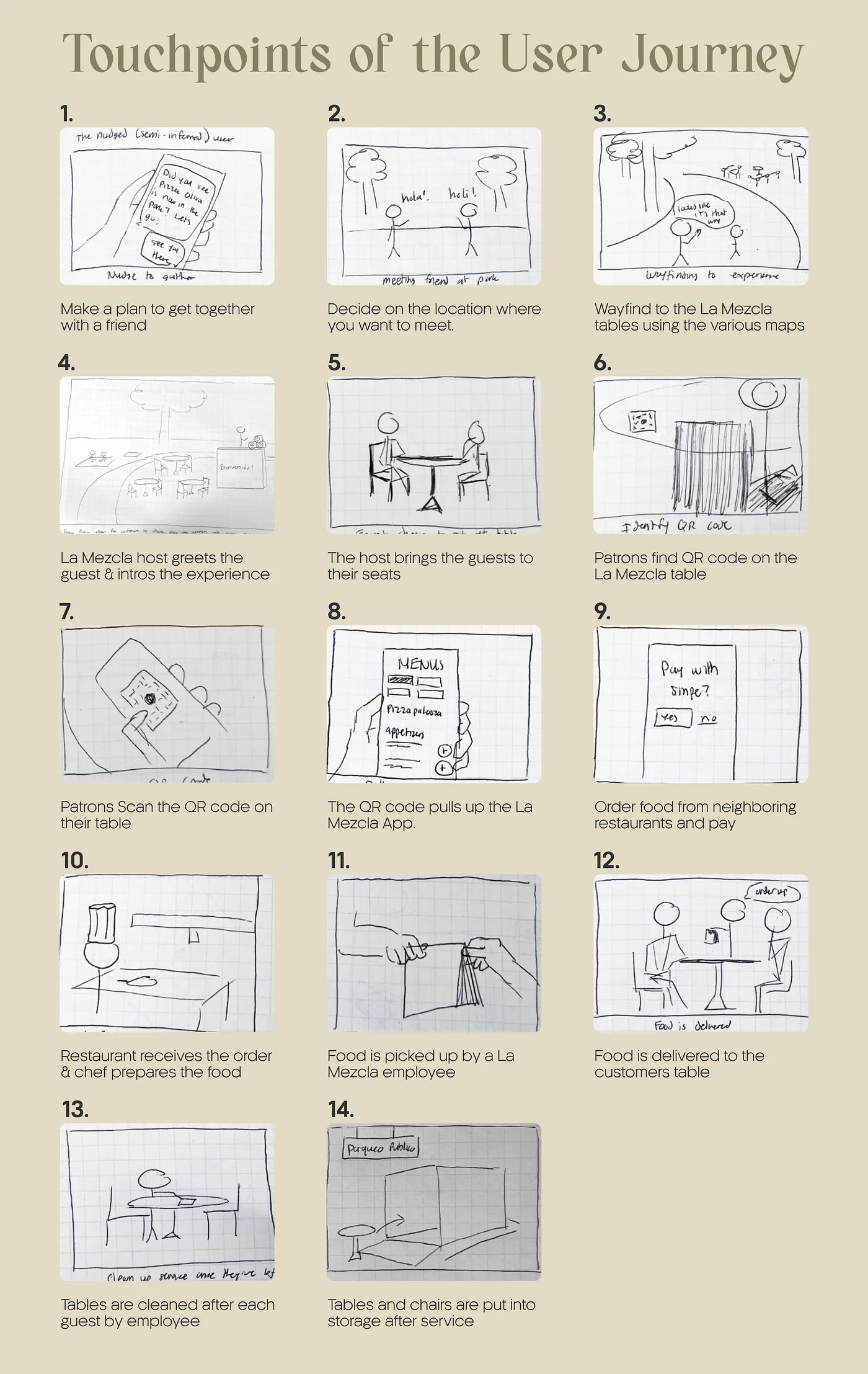
Visitors are welcomed by a host, scan a QR code, browse menus from nearby restaurants, and have their order delivered directly to them in the park. The service creates social energy, supports local business, and brings safety through presence.
Testing La Mezcla
We tested a low-fidelity prototype, simple signage, QR codes, and wayfinding, inside Parque Nacional. Passersby stopped, scanned, and asked questions. As we were testing, many residents expressed curiosity and excitement, showing that people were ready to reclaim the park once it felt welcoming.
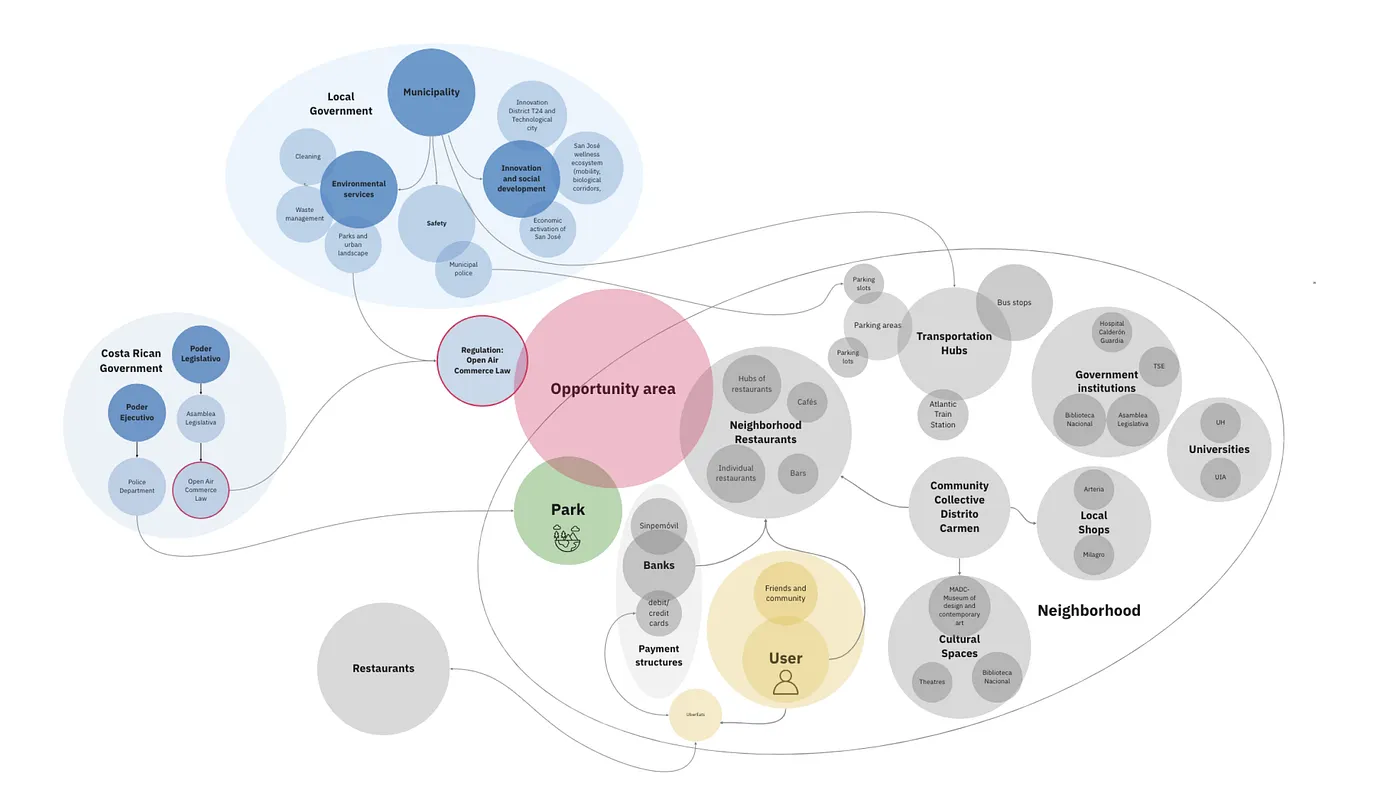
La Mezcla serves as a connective tissue between municipalities, local businesses and residents. To fully understand how to design the service in a way that supported all layers of the ecosystem, we created an ecosystem map showing the interplay between all of the pieces that La Mezcla touched in order to be most effective.
This ecosystem map showed the complex relationships it will exist in, from city government to restaurant coalitions and financial services.
Necessary pieces for the healthy function of La Mezcla:
Digital
Application development
Flow design for resident experience (ordering, receiving food, etc.)
Flow design for business onboarding (municipality applications, ticketing, and fulfillment)
Payment system APIs with local systems like Sinpe Móvil
Operations & Logistics
Hire and train installation, breakdown, and cleanup crew (periodic)
Implement storage solutions (tables, chairs, etc.)
Prepare location with signage, furniture, and lighting (daily)
Breakdown, cleanup, and storage (daily)
Impact & Future Ripple Effects
La Mezcla was designed to create compounding benefits within local economic and social spheres.
Social: revitalized gathering and neighborhood trust.
Economic: Increased visibility for local restaurants.
Its modular design can scale to nearby parks — Parque Morazán and Parque España — creating a corridor of safe, sociable green spaces across downtown San José.
Future Considerations
Include informal and street vendors in the system.
Partner with city programs to sustain the social and environmental benefits over time.
Conclusion
What began as a study of urban mobility became a study of collective memory and revitalization. La Mezcla shows that communities regenerate not just through movement, but through new stories of safety, belonging, and clear communication across systems.