Come Again?! — A Trauma-Informed Game for Intimacy, Curiosity & Connection
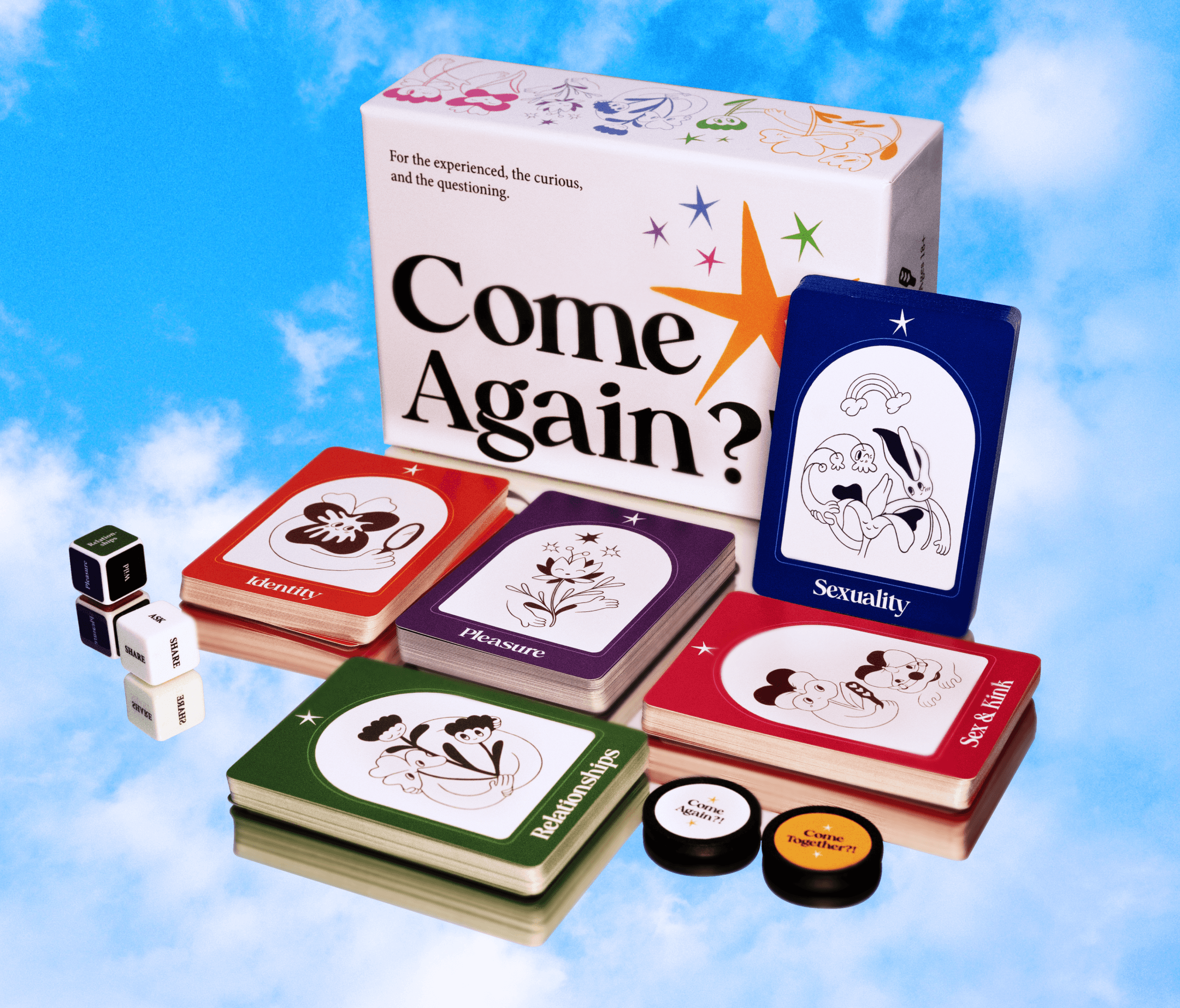
Queerness and gender exist along a spectrum of infinite forms of expression. Yet many people – across identities, relationships, and experiences – rarely have structured opportunities to reflect on their intimacy needs. Come Again?! Is a game designed for Papaya Project as a way for sexual health experts & consumers to explore their intimacy needs.
DAte
Feb 10, 2023
Category
Product Design
Reading Time
10 Min
Opportunity Statement:
How might we create a trauma-informed tool for people across the gender and sexuality spectrum to safely explore individual needs for intimacy, physical touch, and loving relationships?
Client: Papaya Project - Non-Profit
Context:
Papaya Project, a Seattle-based nonprofit dedicated to sexual health education, needed a tool that could:
Be used in clinical and therapeutic settings with professional sexual health educators
Support non-facilitated use for individuals, couples, or groups
Encourage self-reflection, communication, and consent
Feel inherently trauma-informed, queer-affirming, and inclusive
Use Cases:
Non-Facilitated Settings
Solo reflection and exploration
Romantic and/or sexual partners
Friend groups, poly-amorous & non-monogamous groups, or mixed-relationship constellations
Facilitated Settings
Papaya Project workshops
Queer speed-dating events
Sexual health trivia gatherings
Guided sessions with sexual health educators and industry professionals
Ideal Outcomes:
The tool should:
Help people experience sex worth having – sex grounded in desires, boundaries, and agency
Expand personal definitions of sex and intimacy
Encourage openness, curiosity, and listening
Reduce shame around sexuality and intimacy
Support meaningful connection and collective learning
Timeline: 1 year
Our Design Approach:
Expert Interviews
Rapid Iterative Prototyping
Co-design, group & intercept testing sessions
Branding, Visual Identity & Product Design
Population Emphasis:
To ensure broad applicability, we tested with participants who identified as: queer, trans, non-binary, straight, bisexual, non-monogamous, and pansexual. Ages ranged from 23–50+.
Therapists and sexual health educators emphasized the importance of inclusivity, choice, and bodily autonomy.
Discovery Stage
Expert Interviews
We conducted interviews with therapists and sexual health educators who specialize in intimacy, trauma, and queer communities.
We explored questions like:
When are physical vs. digital tools most useful?
How do facilitators create emotional safety? How can games replicate that?
What barriers emerge around shame, regulation, and group dynamics?
Key Takeaways
One of our discovery interviews with therapist Natalie Henry, helped us to shape our understanding of regulation and the benefits of physical objects. Some highlights from that conversation included:
“Dysregulation can be the baseline for people, and they may not know.”
“One half of feeling heard is being listened to, the other is listening.”
“I would give clients a PDF for them to have, but they would never look at it. But just having [an object] around makes a big difference.
How these learnings informed our decision-making:
Ambient discovery
We learned that when tools are physically present in therapeutic spaces, curiosity naturally forms. We referred to this as ambient discovery. This insight led us to design a tactile, physical product.
Feeling heard through listening
We needed to consider what mechanics might be needed to support listening, not just sharing.
Managing dysregulation
Sex and intimacy can be activating topics – this is especially true for people with histories of trauma. We needed to design intentional pauses, choices, and grounding moments, woven throughout the tool.
Guiding Principles
We grounded the design in SAMHSA’s trauma-informed care principles, framing each as a design lens:
Safety
Trustworthiness & Transparency
Peer Support
Collaboration & Mutuality
Empowerment, Voice & Choice
Cultural, Historical & Gender Responsiveness
These principles became evaluative anchors for the game’s mechanics, content, and facilitation guidance.
Auditing The Current Offerings
We conducted an industry audit of sexual intimacy related product interventions.
List of existing tools
Most of these tools assume:
Heterosexuality
Monogamy
Cisgender norms
Supportive or ‘Healthy’ relationships as a default
Why Is This Harmful?
One user review captured the pain of these assumptions:
“They assume you have a normal, healthy relationship to begin with… I felt my face burning as I read the question aloud. I wished I could disappear.”
This reinforced our commitment to designing mechanisms of safety, dignity, and choice at every step.
Low-Fidelity Design
Alongside Papaya Project founder Naomi Price-Lazarus, we co-designed the early content.
Game Elements
Ask / Share Die – determines whether the roller answers the chosen question or invites someone else to answer
Category Die – 6 sided die that corresponds with category decks: Relationships, Sex & Kink, Identity, Pleasure, Sexuality, Wild
Question Decks – 5 decks of category-specific cards
Dig Deeper Cards – invitations for the person answering a question to share more.
Creating Safety Through Game Mechanics
Our primary driver for co-creating consent was within the instructions. We felt this a good place to create a collective understanding of what the game will involve and for individuals to be able to be self-responsive with how vulnerable they were willing to be with the group they were playing with.
Read the instructions
Within the instructions we included ‘Pledge to Listen’ – which is an opening intention that allows everyone in the room to co-create consent. Some of the queries from this section include:
Do I feel safe to share with the people that are around me?
Are there any categories of questions that I am not comfortable with sharing today?
Roll the dice
The ‘ask/share’ die determines whether you, or someone else within the group answers the question.
The ‘category’ die determines the category deck you pull from.
Pick Up A Card
Pull a card, and read aloud. The chosen person will answer the question.
Dig Deeper
Other players can use a ‘dig deeper’ card if they would like clarification or more insight from the person answering the question.
Winning the game
In a group setting, the first player to win four categories, wins the game.
Research Stage
Low-fidelity testing
Using custom-coded digital dice and a Miro whiteboard, we tested early mechanics remotely—allowing quick iteration prior to physical prototyping.

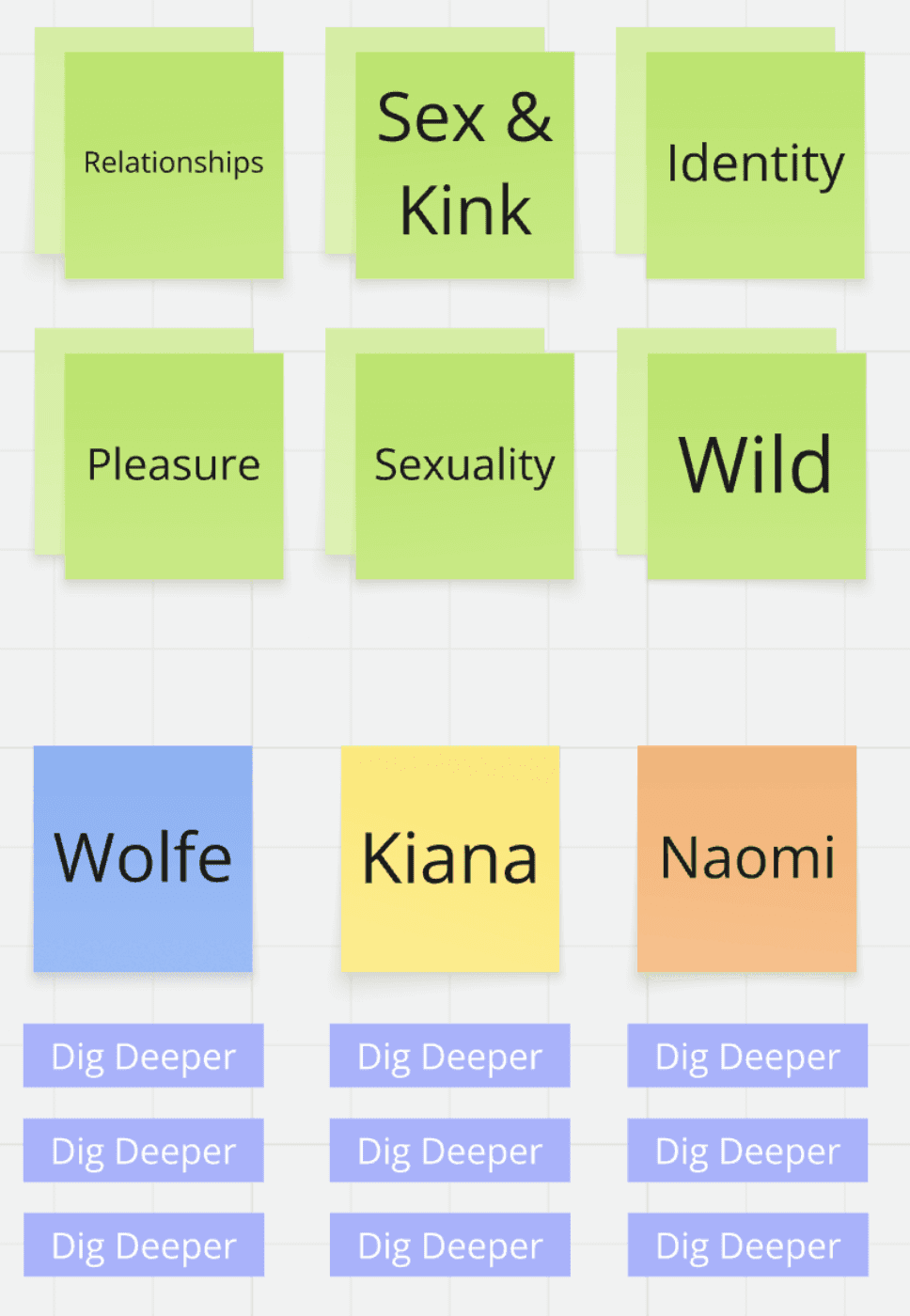
We met with sexual health experts to test the low-fidelity mechanics and content of the game. Some questions we focused on included:
Are the mechanisms we are using to create a safer environment for connection clear in both their use and value?
Are the questions that we test able to be answered by a diverse population of people? Are they inclusive to experiences outside of the cishet and heterosexual norm?
Are the teaching moments in the game clear and useful?
Key Insights:
Dig Deeper Cards
These were initially unclear. Particular confusion around where they get placed after being used.
Teaching moments
One of our experts, Kiana, shared how valuable it was to have teaching moments throughout the game and how not assuming that everyone has the same baseline sexual education is an accessible approach
Before, During, and aftercare
Our main source of consent and agency was at the beginning of the game. We used the ‘pledge to listen’ in the instructions as a key source of intention setting. We received feedback prompting us to inspect what moments of care might look like before, during, and after the game.
How we adjusted the game:
Glossary
As a way to organize content and lean into moments of education without it being too disruptive to the game, we created a glossary of terms included as a point of reference in the instructions.
Personal Gameplay Cards
We added cards that include suggestions for care prior to gameplay, during gameplay, and after gameplay. This decision was to increase the capacity for users to be self-responsive to their needs.
Moments of choice in gameplay
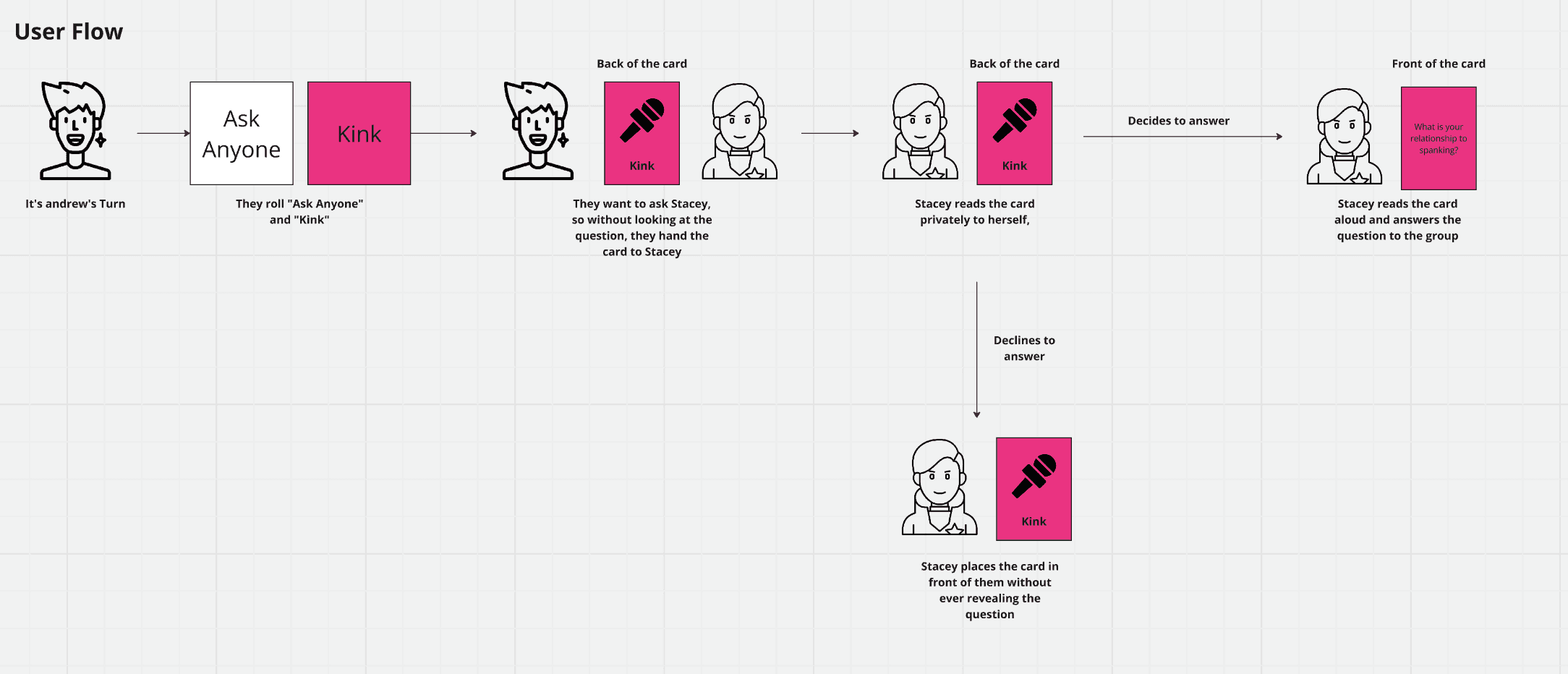
Our experts emphasized the importance of giving players ways to decline a question without losing dignity – especially in group settings, where subtle social pressure can make opting out feel difficult.
To support this, we built a deliberate moment of private choice into the gameplay. When the dice select a player, the card is handed to them to read silently first. They then decide whether they want to answer the prompt before it is shared aloud. This mechanism reinforces agency, reduces shame, and protects personal boundaries while still enabling meaningful connection.
Group Testing
Group Testing Design
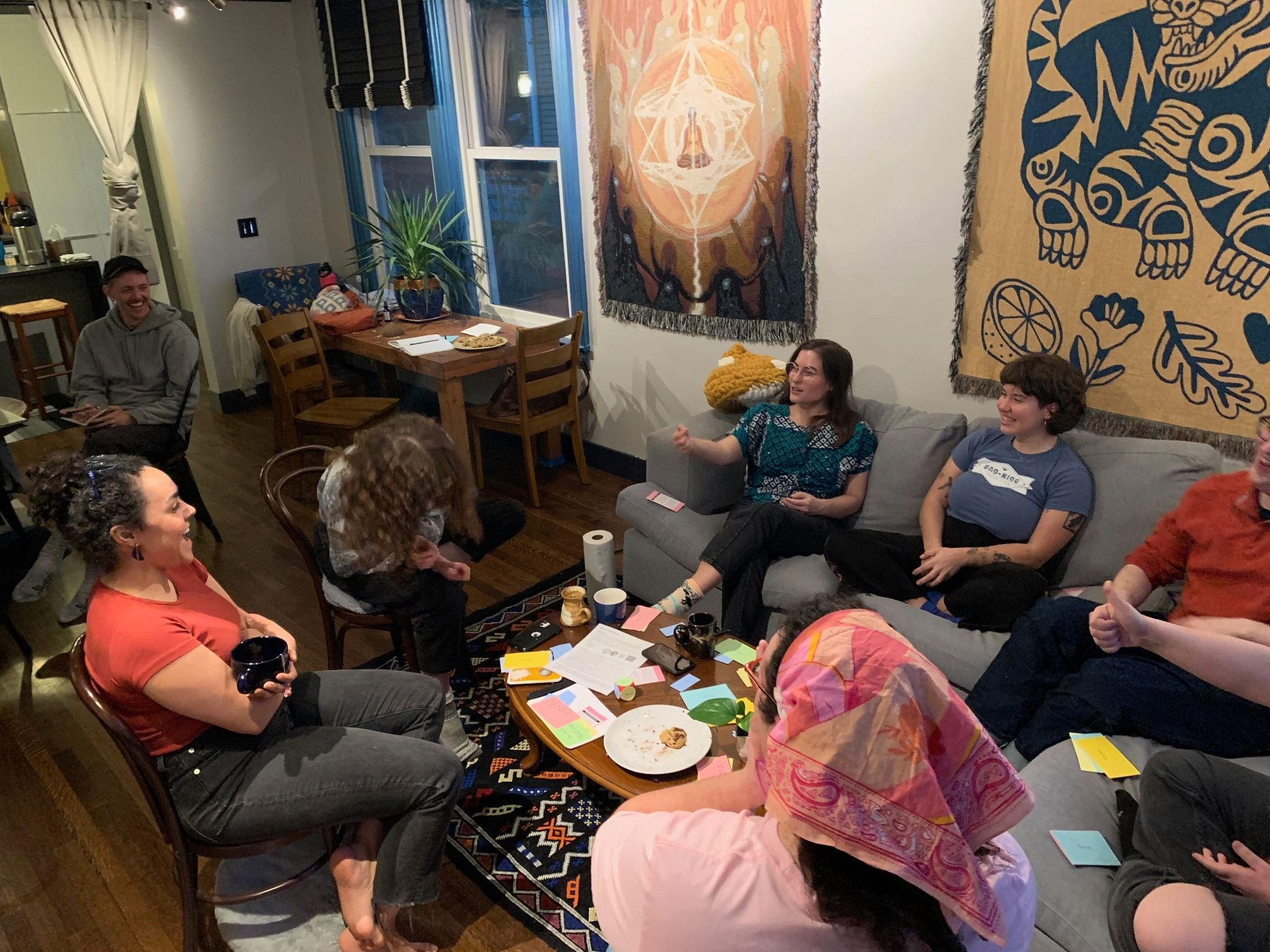
We invited a mixed group of strangers, acquaintances, and sexual health experts and non-experts to test the mid-fidelity experience. These seven participants were asked to run through the gameplay with as little assistance from us as possible. This was to see where they might be getting stuck, and point of unnecessary friction in the game.
Insights & Decisions From Group Testing
Personal Gameplay Card → Integrated Care in Instructions
Insight:
The personal gameplay card, which offered care prompts before, during, and after play, was consistently glossed over once the game began. Participants didn’t return to it, indicating that support cues needed to stay visible throughout the experience.
Decision:
We moved these care prompts into the instructions to be read aloud at the start of each session. We added prompts for what acts of care might look like for after the game had been completed.
Moment of Choice → Clearer Instructional Emphasis
Insight:
Participants unanimously said the private moment of pause before answering a question was extremely helpful for checking in with their comfort level. Several noted that the mechanic was so valuable it needed a stronger callout.
Decision:
We highlighted the moment of choice more explicitly in the instructions, clarifying how it works and why it matters for emotional safety.
Audience Fit → Validated for Therapeutic & Community Use
Insight:
Participants envisioned using the game in therapy sessions, client work, group therapy settings, and queer friend groups—affirming broad applicability across facilitated and non-facilitated contexts.
Decision:
We refined the instructions and content with these audiences in mind, ensuring inclusive language and trauma-informed grounding suitable for both professional and casual environments.
Dig Deeper Cards → Come Again?! + Come Together Tokens
Insight:
The “Dig Deeper” cards felt too scarce (each player only had three), making them feel precious and limiting. Participants also wanted a way to open certain questions to the group when collective curiosity was sparked.
Decision:
We replaced the cards with a double-sided token:
“Come Again?” — invites deeper individual sharing
“Come Together” — opens the question to group reflection
This made the mechanic more flexible, responsive, and aligned with group dynamics.
Accessibility Issues → Improved Contrast in High-Fidelity Design
Insight:
Low color contrast on the dice made it hard to distinguish categories and select the correct card deck.
Decision:
In the high-fidelity version, we adjusted color contrast across dice and card decks to maximize readability and accessibility.
Intercept Interviews
Prior to moving onto final print-ready designs, we adapted these changes and ran some intercept interviews in Seattle’s cal-anderson park
Video of intercept interviews
High Fidelity Design
Images and videos of high fidelity design
Event Photos
Playthrough Videos
Impact
Today, Come Again?! is played across Seattle at Papaya Project workshops and has found a home in therapeutic spaces around the country, where sexual health educators use it to support deeper reflection and connection. Our first print run sold out—mostly to buyers in the U.S., with a few early adopters from abroad joining in as well.
Testimonies:
"This will allow people to have those BIG conversations around sex, relationships, and pleasure, in a fun and curious environment. Reducing the anxiety of vulnerability for many.” - Ariadna Rodriguez Barclay (she/they), CHSE, Sex Educator and Artist
"Come Again is a fun, sex positive game that encourages you to learn more about your own relationship to sex and sexuality, and to get comfortable exploring these topics in intimate or group settings. If you're looking for a playful and destigmatizing way to dig deeper with partners, friends, students or clients, look no further! Come Again will have you laughing, learning, reflecting, and wanting to go another round!" - Shani Redlich (she/her), Sex Educator
